 Permis Prêt
Quebec road signs: what do the shapes and colours mean?
You can tell which family a sign belongs to before you even read it: shape and colour do most of the work.
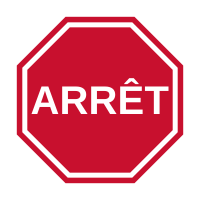
Short answer: in Quebec, black and white is used for rules (obligations and prohibitions), yellow for hazards, orange for road work, and green, blue or brown for information. Some shapes are reserved: the red octagon for the stop sign, the yellow-green pentagon for the start of a school zone, and the diamond for hazard and road-work signs.
The four families of signs
The SAAQ’s Guide de la route (the official driver’s handbook, French edition) sorts signs into four groups (ch. 3, “Panneaux de signalisation”):
- Regulatory (prescription): what the law requires or forbids, such as stop, one way, speed limit or no turns. Everyone must obey signs installed under the Code de la sécurité routière, Quebec’s Highway Safety Code (art. 310).
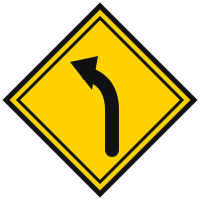
- Hazard (danger): a warning that something risky is ahead, such as a curve, a slippery surface or a crosswalk. You may need to slow down, stop or change direction.
- Information (indication): help with finding your way and services: distances, directions, street names, attractions.
- Road work (travaux): a work site on or beside the road. These signs can do the job of any of the other three families, but on an orange background.
Colours and shapes at a glance
| What you see | What it means |
|---|---|
| Red octagon | Reserved for the stop sign (ARRÊT) |
| Red and white triangle, point down | Reserved for the yield sign (Cédez le passage) |
| Black and white (often a rectangle) | Regulatory: an obligation or a prohibition |
| Yellow diamond | Hazard |
| Orange diamond or orange sign | Road work |
| Yellow-green pentagon | Start of a school zone |
| Green, blue or brown | Information (routes, services, tourist attractions) |
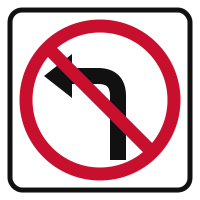
| Red circle with a diagonal bar | Whatever is drawn inside is prohibited |
| Green circle | Whatever is drawn inside is mandatory |
Source for the table: Guide de la route, ch. 3, “Formes et couleurs des principaux panneaux” and “Les pictogrammes”. Among information signs, the handbook links brown to public tourist attractions, blue to tourist information and services, and red to emergency equipment. Yellow-green is also used for the sign that warns you of a school zone or school crossing ahead.
Reading a sign in three seconds
Decode it in this order: shape (octagon, triangle, diamond?), then colour (rule, hazard, work, information?), and only then the symbol or text. The handbook notes that regulatory, hazard and work signs rely mostly on arrows and pictograms, while information signs carry words and numbers.
A small plate mounted under a sign (a panonceau) adds detail: the hours a rule applies, a distance, or “toutes directions” (all-way) under a stop sign.
One common mix-up: a small yellow plate showing a speed under a hazard sign is a recommended speed, while a limit on a white or orange sign is mandatory (Guide de la route, ch. 3, “Vitesse recommandée” and “Limitation de vitesse”).
On the test you may see the French names, so it helps to know a few: Arrêt (stop), Cédez le passage (yield), Travaux (road work), Zone scolaire (school zone).
Key points for the test
- Octagon = stop; pentagon = start of a school zone; diamond = hazard (yellow) or road work (orange).
- Black and white = regulatory, so it is a rule you must follow.
- Red barred circle = prohibited; green circle = mandatory (no other move allowed).
- Green, blue, brown = information only.
Original questions with an explanation and a source, “Road signs and signals” section.
Practise for free
See also
- School zone speed limit in Quebec
- Work zones: flaggers, orange signs and doubled fines
- SAAQ Class 5 knowledge test: how many questions?
Official sources
- Code de la sécurité routière (Highway Safety Code, CQLR c. C-24.2), s. 310
- SAAQ, Guide de la route (4th ed., 2024, French), ch. 3, “Panneaux de signalisation”, “Formes et couleurs des principaux panneaux”, “Les pictogrammes”, “Vitesse recommandée”. English edition: Driver’s Handbook
General information page, current as of 2026-10-28. If in doubt, the official text prevails. Rules can change: check saaq.gouv.qc.ca and legisquebec.gouv.qc.ca.