 Permis Prêt
Yellow road lines in Quebec: when is passing allowed?
Solid, double, broken or combined: which side the broken line is on makes all the difference.
Short answer: you may cross a broken yellow line to pass when it is safe. You may not cross a solid line, single or double. With a combined line (solid + broken), you may pass only if the broken line is on your side when you start. The Code has a few exceptions, such as passing a cyclist or farm machinery.
Why yellow?
In Quebec, yellow markings separate, among other things, lanes where traffic moves in opposite directions, while white markings separate lanes on a one-way roadway (Guide de la route, ch. 3, “Couleurs des marques sur la chaussée”). A yellow centre line is a reminder that crossing it puts you in the lane of oncoming traffic.
Line by line
| Marking | Cross it to pass? |
|---|---|
| Broken (dashed) line | Yes, if it is safe |
| Single solid line | No |
| Double solid line | No |
| Combined line, broken on your side | Yes, if safe; finish before the broken line ends |
| Combined line, solid on your side | No |
| Hatched area | No |
Sources: Code de la sécurité routière (Quebec’s Highway Safety Code), s. 326.1; Guide de la route, ch. 4, “Les lignes de démarcation des voies”. Crossing a line you may not cross carries 3 demerit points (Regulation respecting demerit points, Schedule, item 7).
Exceptions in the Code
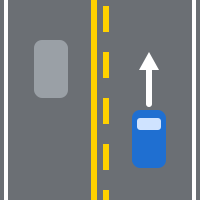
Even with a solid line, the Code lets you cross it, when it is safe, to (s. 344):
- pass farm machinery, a vehicle displaying the slow-moving vehicle sign, an animal-drawn vehicle, a cyclist or a pedestrian;
- move back to the right after passing.
You may also cross it safely for other manoeuvres (s. 326.1, second paragraph): leaving a blocked or closed lane, turning left onto a private road or property, pulling right onto the shoulder or private property, entering the road from the shoulder or a driveway, or moving into a centre lane reserved for left turns in both directions.
When the line allows passing but the situation doesn’t
A broken line is not a green light. The Code forbids using the opposing lane to pass when approaching the top of a hill or in a curve without enough visibility, or near an intersection, a railway crossing, a tunnel or a marked crosswalk (s. 345). You also may not pass if a driver behind you has already started to pass, if visibility is too poor, or if the other lane is not clear far enough ahead to get back safely (s. 348).
And when you are the one being passed, do not speed up (s. 340).
Key points for the test
- Yellow = opposite directions; white = same direction.
- Solid = don’t cross to pass; broken = allowed when safe.
- Combined line: the line on your side is the one that counts.
- Exceptions: cyclist, pedestrian, farm machinery, slow-moving vehicle, animal-drawn vehicle, when safe.
Original questions with an explanation and a source, “Road signs and signals” section.
Practise for free
See also
Official sources
- Code de la sécurité routière (Highway Safety Code, CQLR c. C-24.2), ss. 326.1, 340, 344, 345 and 348
- Regulation respecting demerit points (CQLR c. C-24.2, r. 37), Schedule, item 7
- SAAQ, Guide de la route (4th ed., 2024, French), ch. 3, “Couleurs des marques sur la chaussée”; ch. 4, “Les lignes de démarcation des voies” and “Dépassements interdits”
General information page, current as of 2026-10-28. If in doubt, the official text prevails. Rules can change: check saaq.gouv.qc.ca and legisquebec.gouv.qc.ca.